
E0, E1, E2 Standards: What They Are and Why They Matter in Wood-Based Panels?

Moc Phat applies European standards to all products.
In the context of more and more homeowners choosing industrial wood furniture for interior construction, the requirement for health and safety is also of concern. So what are the E0, E1, E2 formaldehyde standards? Why does industrial wood need this certificate? In this article, let's learn about the above standards with Moc Phat and find a suitable solution for your living space.
What is the Formaldehyde emission concentration?
Formaldehyde emission concentration is an index measuring the amount of formaldehyde gas emitted from industrial wood under standard conditions. This index is measured in milligrams per liter (mg/l) or parts per million (ppm), to reflect the level of safety when using materials in living spaces. Therefore, controlling and limiting the formaldehyde content in construction materials and interiors is extremely necessary to ensure long-term safety for users.
To ensure accuracy, measuring formaldehyde emission concentrations must be carried out under strict control procedures. This is also the basis for classifying whether industrial wood meets E0, E1 or E2 standards. This helps consumers choose products that suit their needs and desired safety level.
Accordingly, Formaldehyde is known as an easily emitted compound, commonly used in the production of glue, synthetic resin and construction materials. For the industrial wood industry, formaldehyde often exists in adhesives to create bonds between layers of wood. In addition, formaldehyde is also known by other names such as formalin, formaldehyde, methyl aldehyde, ...
In addition, this compound is also widely used in a number of fields such as: medicine, textiles, agriculture, ... To make preservatives in laboratories or to treat fabrics to prevent wrinkles or to use as pesticides. Therefore, the use of formaldehyde needs to be strictly controlled in terms of concentration to limit the impact on human health.

How harmful is formaldehyde to the health of users?
After the production process, a part of Methyl Aldehyde is still left and emitted into the air, if it exceeds the allowable threshold, it will affect the health of users. This compound has a pungent smell, which many people still call the "new smell" when opening the packaging or coming into contact with newly produced wooden furniture.
Formaldehyde is a strong irritant to the respiratory system, causes eye allergies and can even increase the risk of cancer if exposed for a long time. Therefore, limiting the concentration of formaldehyde in industrial wood is a necessary step to protect consumers. For developed countries, strict regulations on formaldehyde are also applied and have become a mandatory measure in the international furniture manufacturing industry. If you need to use quality boards with formaldehyde standards in industrial wood to ensure export, please contact Moc Phat.
For a person with a normal physical condition when exposed to this compound for a period of time, it can lead to some irritation. Specifically, some symptoms include: watery eyes, headache, difficulty breathing, burning sensation in the throat. In the long term, these toxic gases can harm the skin, respiratory system or diseases related to white blood cells. Note for pregnant women, depending on their constitution, it can lead to deviations or mutations in chromosomes affecting the development of the fetus. You can refer to product lines with EPA, Carb P2, Super E0 or E1 standards to ensure that the formaldehyde content is controlled. In accordance with health safety requirements in living spaces, minimizing the risk of toxic gas emissions and contributing to creating a clean living environment.

Why industrial wood needs to meet E0, E1, E2 standards
Some studies have shown that the concentration of formaldehyde emitted in MFC, MDF, HDF boards is classified as a substance that can increase the risk of cancer. Therefore, controlling the amount of formaldehyde is a necessary step, given the current abuse of this active ingredient in the industrial wood manufacturing industry. The E emission standards help measure and control the concentration of Methyl Aldehyde in industrial wood furniture products. To ensure that these furniture products limit the impact on the health of users.

Some standards E0, E1, E2, EPA, Carb P2
Accordingly, the E0, E1, E2 standards are considered a measure to classify the level of formaldehyde emissions. Each level reflects the amount of emissions of this compound into the environment during use. This standard is divided into many levels as follows:
Formaldehyde standard F★★★★ (Japan)
Standard F★★★★ (Japan) is one of the groups with the lowest formaldehyde emission levels in the industrial wood industry. It is regulated with an emission level of ≤ 0.3 mg/L according to the JIS A 5908*3 testing method. With this quality, it is often used for interior works in hospitals, high-end apartments, key projects, etc. This certificate is almost equivalent to the Super E0 standard. Currently, Moc Phat is a commercial partner with EGGER using boards that meet this standard, you can refer to the colors of EGGER boards. For more options in the construction and interior design stages.
E0 standard
E0 standard is also one of the groups with low formaldehyde emission levels, recommended for interior construction. E0 standard with emission concentration ≤ 0.3 mg / L according to JIS A 1460: 2021 testing method is safe for the health of users. With low formaldehyde content, it is often preferred in closed living spaces such as bedrooms, children's rooms, schools, etc. In addition, with this standard, you can also process furniture for export to demanding markets or projects that require high quality materials.
EPA Standard
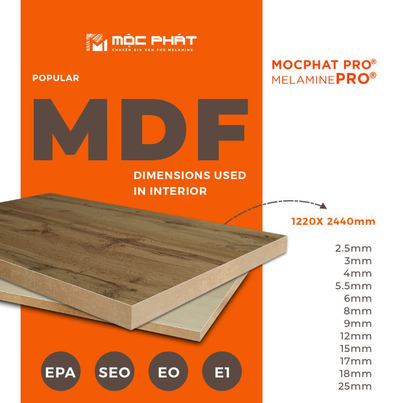
EPA emission standard with formaldehyde content ≤ 0.09 Ppm according to ASTM D6007 test method for PB. For MDF boards, this concentration fluctuates with thin boards ≤8mm: 0.13 and >8mm: <0.11 according to ASTM D6007:2014 standard. In the US market, this standard is commonly used to strictly control the formaldehyde content emitted from industrial wood products in living spaces. Thanks to the strict limit on emission concentration, materials that meet EPA standards are considered safe for health, minimizing the risk of respiratory irritation, allergies or long-term effects on the body when used in closed environments such as homes, schools or offices.
Carb P2 Standard
CARB P2 stands for "California Air Resources Board Phase 2" - one of the most stringent formaldehyde emission control standards in the United States. This standard is not only a mandatory requirement for products circulating in the state of California but is also applied by many countries and international manufacturers as a commitment to quality and consumer health.
E1 standard
E1 standard with an emission threshold of ≤8 Mg/100g according to the BS EN ISO 12460-15:2005 testing method is commonly used in the Vietnamese and Asian markets. At this threshold, Formol emissions with a limited dilute concentration have limited effects on the health of direct users. E1 standard is often used to make furniture at an accessible price to many customer segments.
E2 standard
E2 standard has a formaldehyde emission level ranging from >8 to ≤30 according to the BS EN ISO 12460-5:2015 testing method. Compared to E0 and E1, this type should be carefully considered before using in a closed space. Normally, E2 standard wood panels are used in the processing of low-cost furniture. Aiming at the popular market segment and products that do not require strict environmental standards.
This classification not only helps manufacturers orient raw materials, but also helps consumers recognize and choose suitable products. With the modern lifestyle, a clean living space is uncompromising. Understanding and prioritizing materials that meet appropriate formaldehyde standards will contribute to building a safe environment for the whole family.

Why do Emission Standards in Industrial Wood Need to Be Controlled?
As Moc Phat mentioned, industrial wood contains formaldehyde, which is one of the harmful agents to human health. If not controlled, the level of emissions from industrial wood will not only affect human health, but also directly affect the surrounding living environment. In closed spaces, formaldehyde gas easily accumulates, causing indoor air pollution.
Especially in large cities, small apartments often use a lot of industrial wood materials. If not well controlled, consumers can be continuously exposed to excessive formaldehyde content. This is the silent cause leading to chronic diseases or cancer.
Because of the abuse of formaldehyde in the industrial wood manufacturing industry, the Emission Standards (symbol E) have been established to control the safety level. This set of standards was issued by the Council of European Countries and is currently widely applied in many countries. The purpose is to measure and control the concentration of formaldehyde emitted from wooden furniture products, to ensure that it does not negatively affect the health of consumers.
On the other hand, controlling formaldehyde in industrial wood also creates conditions for the wood manufacturing industry to develop more sustainably. When products meet standards, competitiveness increases significantly, which is also the reason why units distributing products that are safe for consumers' health are always highly appreciated in the international market.
Why do manufacturing enterprises need E0, E1, E2 certificates?
Formaldehyde standard certification is not only proof of product quality, but also a tool to build trust with customers. In the context of consumers increasingly paying attention to health, products that meet E0 or E1 standards are always the priority choice.
For export enterprises, this standard is one of the prerequisites for bringing industrial wood furniture products to demanding markets. In addition, certified products also help businesses increase brand value. Customers are willing to pay higher prices for safe materials, with clear origins and transparent technical standards. You can refer to the quality standards of Moc Phat wooden boards for more detailed information.
How to test and confirm which E standard products?
To determine the level of formaldehyde emissions, testing must be performed at qualified laboratories. The process usually includes measuring the amount of emissions from the board sample under standardized environmental conditions.
Therefore, the verification test must be conducted through reputable units with professional capacity and licensed by competent authorities. This not only ensures the accuracy of the measurement results but also helps businesses and consumers feel more secure in the process of using the product. At the same time, certificates related to emission standards, especially formaldehyde, must also be issued legally in accordance with current legal regulations, to avoid fraud or use of documents without legal value.
In addition, at Moc Phat, industrial coated panels are always strictly controlled in terms of origin and quality standards. We operate with a modern ERP system, helping to monitor the entire process from raw material import to finished product distribution. Thanks to that, each shipment has clear traceability information with the MO code next to the board. Ensuring transparency and trust for partners and end customers.
Through this article, we hope you have clearly understood what the formaldehyde standards E0, E1, E2 are? Why does industrial wood need this certificate? Grasping this information helps consumers make informed decisions. The E standard not only ensures health safety, but also contributes to building a more sustainable and friendly living space. Standards are not just technical specifications, but also a commitment to quality and responsibility to the community. Start with the small details – choose the right one to protect your family's health every day.
Related news