
Understanding EPA/Carb P2 Standards in the Woodworking Industry

Formaldehyde is a chemical compound commonly used in the production of wood-based panels. However, it is also a toxic substance that can cause serious health problems if exposed to for an extended period.
To protect consumer health, formaldehyde emission standards for wood-based panels have been established:
1. EPA (Environmental Protection Agency) Standard:

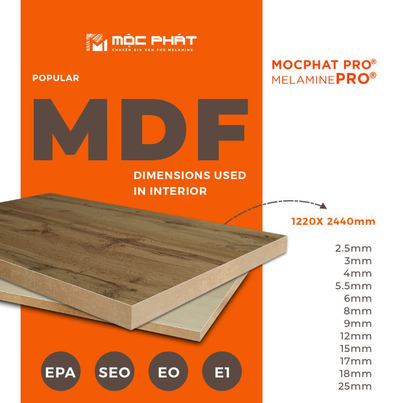
• The allowable formaldehyde emission level depends on the product brand, type of core board and thickness, the allowable emission level fluctuates: from 0.09ppm to 0.13 ppm (parts per million).
• Moc Phat built a separate warehouse for EPA standard products in 2020, 4 years ago.
2. Carb P2 (California Air Resources Board Phase 2) Standard:

• Allowable formaldehyde emission levels:
o Particleboard (Okal board): 0.09 ppm
o HDF board: 0.05 ppm
o MDF board: 0.11 ppm
Applies to: Wood-based panels used in furniture, housing, and other construction projects.
Benefits: Ensures the safety of both the manufacturer and the end consumer.
3. Strict Storage Requirements:
• For EPA and Carb P2 standard products, Moc Phat has built specialized warehouses to ensure no back-emission occurs.
• This is why Moc Phat has more than 4 specialized warehouses for each type of panel with different standards.
4. Moc Phat's Quality Improvement Goals:
• Both EPA and Carb P2 standards aim to limit formaldehyde emissions from wood-based panels to protect the health of manufacturers and consumers.
• Both EPA and Carb P2 standards meet the criteria for green, clean, and environmentally friendly products.
• However, the EPA standard is more widely used because it can be used throughout the United States, while the Carb P2 standard is limited to the state of California.
5. Moc Phat's Quality Standards:
Related news